
Bridging the Energetic Realms: Frequency, Coherence, and the Biology of Regulation
This book establishes the foundation of the series by translating “energy” into biologically grounded processes of regulation, timing, and coherence. Rather than relying on abstract or mystical explanations, it reframes energetic experience through the lens of nervous system dynamics, metabolic stability, and cellular signaling. The result is a clear, structured model that allows both practitioners and scientifically minded readers to understand how perceived energetic shifts correspond to measurable changes in human physiology. It functions as the entry point to the series, building a shared language that replaces ambiguity with mechanism.

The Architecture of Coherence: A Systems Framework for Human Biological Regulation
This volume expands the work into a formal systems model, introducing a multi-layered framework that explains how regulation operates across meaning, nervous system function, metabolism, structure, and cellular processes. It presents coherence not as an abstract ideal, but as a measurable state emerging from coordinated function across these layers. The book outlines how regulatory drift develops, how compensation patterns form, and how long-term instability leads to dysfunction. Written with a more technical and structural focus, it serves as the central framework of the series and provides a model that is both clinically usable and academically defensible.
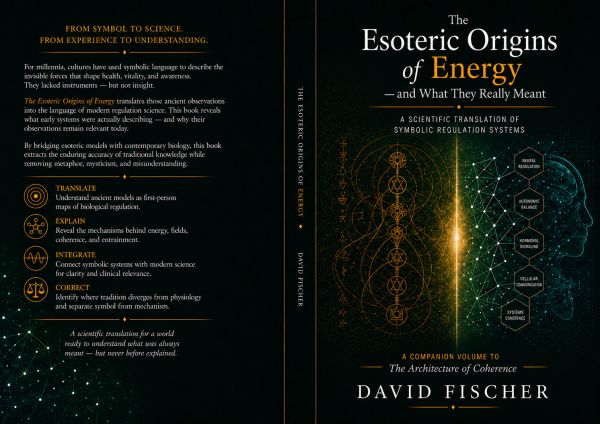
The Esoteric Origins of Energy — and What They Really Meant
This companion volume examines historical energy-based traditions through a modern scientific lens, separating symbolic description from biological mechanism. It argues that early systems were not describing mysterious forces, but organizing first-person experiences of physiological regulation into communicable frameworks. By translating concepts such as flow, blockage, and vitality into mechanisms like autonomic state, structural tension, and metabolic capacity, the book preserves the observational accuracy of traditional systems while removing metaphysical interpretation. Its purpose is not to validate or dismiss these traditions, but to clarify what they were actually describing and integrate those insights into a scientifically coherent model of regulation.
Upcoming Volumes
The Practice of Coherence: Applying Energetic Biology Without Claims, Hype, or Overreach
This volume addresses the most difficult part of the field: application. It defines how coherence-based principles can be used responsibly without collapsing into outcome claims, exaggerated promises, or misinterpretation. The book shifts the concept of “use” away from intervention and toward the support of biological conditions that allow self-regulation to emerge. It emphasizes restraint, ethical boundaries, and the relinquishing of outcome ownership, positioning coherence as a condition rather than a tool. By establishing clear limits on what can and cannot be claimed, it provides a disciplined framework for applying energetic biology in wellness, education, and observational contexts while preserving scientific and institutional credibility.
Coherence-Based Reiki: A Regulation-Centered Approach to Energy Practice
Coherence-Based Reiki reframes energy work through the lens of biological regulation. Rather than relying on abstract or belief-driven interpretations, this book positions Reiki as a structured method for influencing the body’s ability to stabilize, adapt, and recover across multiple systems.
At its core, the text argues that what is often described as “energy” can be more precisely understood as patterns of regulation—interactions between the nervous system, metabolic processes, structural dynamics, and cellular signaling. The practitioner’s role is not to “add” or “direct” energy, but to create conditions in which the system can return to coherence.
The book is built on a systems-based framework that aligns with the broader architecture introduced in Bridging the Energetic Realms and expanded in The Architecture of Coherence. Within this structure, Reiki is repositioned as a regulation-support modality—one that operates through timing, restraint, and consistency rather than force or intensity.
Inside, readers will find:
- A clear breakdown of how regulation breaks down over time (regulatory drift → compensation → instability)
- A structured model for applying Reiki in a way that prioritizes system stability
- Clinical framing that separates subjective experience from underlying mechanism
- Case-based examples demonstrating variation in response and progression
- Practical guidance on session structure, pacing, and practitioner conduct
The tone remains deliberately grounded. Claims are limited to what can be supported within a regulation framework, and where evidence is incomplete, the book treats traditional interpretations as phenomenological descriptions rather than confirmed mechanisms.
Coherence-Based Reiki is written for practitioners who want a more rigorous foundation for their work, as well as for individuals seeking a clearer understanding of how energy-based practices can fit within a modern, systems-oriented view of the body.
This is not a departure from Reiki.
It is a refinement—one that emphasizes coherence, stability, and the measurable processes that support long-term regulation.
The Coherence Model: A Systems Framework for Measurement, Validation, and Clinical Application
This book converts the series from conceptual framework into a structured, testable model. It defines coherence in operational terms, introduces measurable domains across the five layers of regulation, and establishes methods for assessment, comparison, and validation. By specifying variables, relationships, and conditions for disproof, it moves the work from interpretation to evaluation. The model includes structured scoring systems, data collection protocols, and pathways for research and institutional integration. Its purpose is not to finalize the framework, but to make it measurable, challengeable, and capable of evolving under observation and testing.